
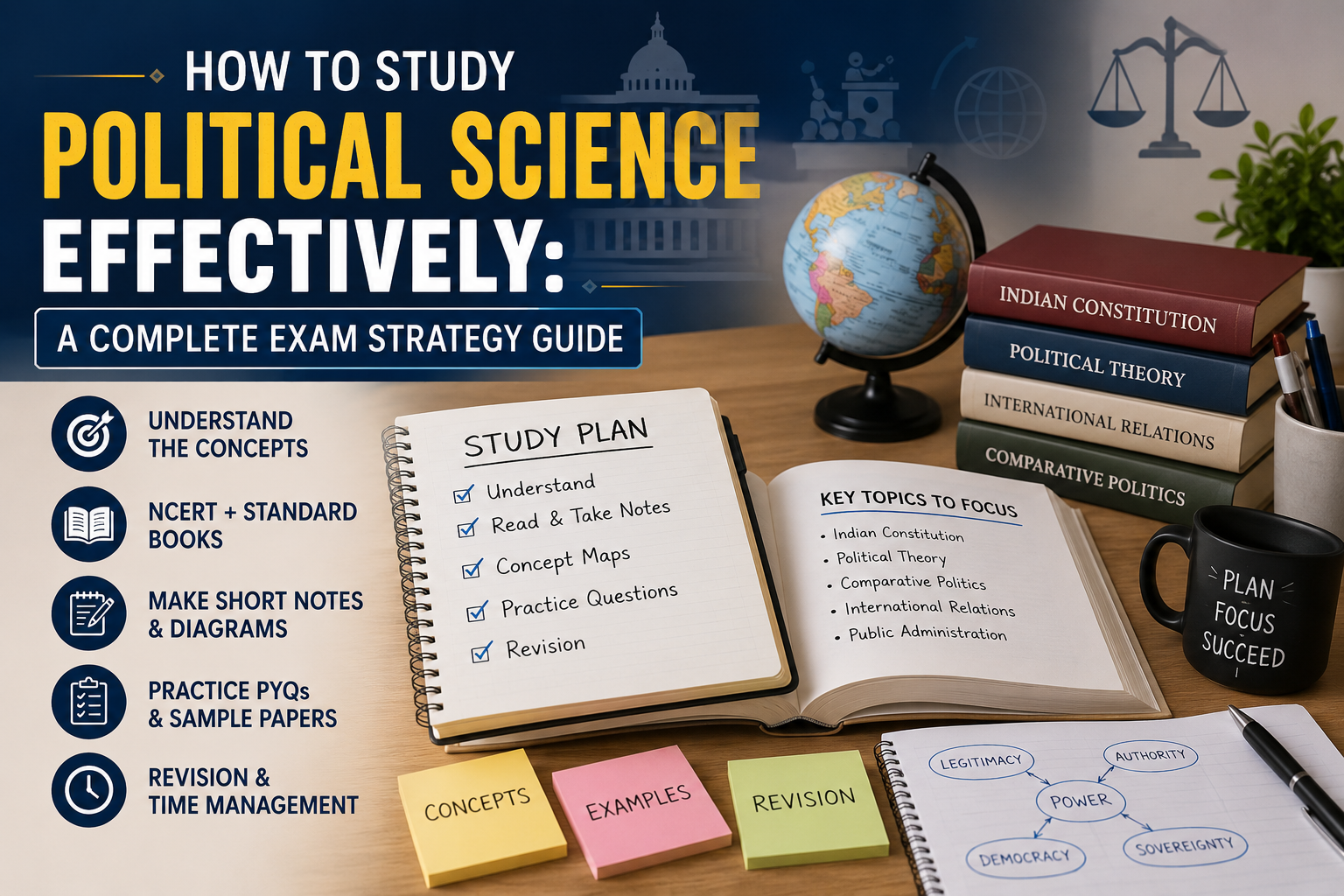
For BA Political Science students who want a structured, honest approach to preparation, not generic advice
Most guidance for Political Science students focuses on surface-level habits: read more, take better notes, form study groups, stay updated with current affairs. All of this is true in a general sense and largely useless without understanding what Political Science exams are actually testing. They are not testing memory. They are testing the ability to construct an argument to take a complex political question, deploy relevant theory, support it with evidence, and arrive at a defensible position.
Students who understand this perform well. Students who do not memorise extensively, reproduce content accurately, and still produce mediocre answers because the examiner was looking for reasoning, not recall. The question of how to study for a political science exam is therefore primarily a question about how to develop argumentative and analytical capability, not just knowledge acquisition.
This guide is built around that understanding. It covers what to study, how to study it, how to structure your preparation across the weeks before an exam, and how to perform on the day. Every section is specific and actionable because generic advice about "staying focused" and "believing in yourself" does not help anyone pass an exam on comparative political systems.
- Understanding What Political Science Actually Requires
- A Structured Study Plan: Eight Weeks to Exam Ready
- What to Study Topics, Weight, and Exam Strategy by Subject
- How to Make Notes That Actually Help You in the Exam
- Study Strategies That Make a Measurable Difference
- Integrating Current Affairs: How to Do It Systematically
- Building the Skills That Politics Requires & Not Just the Knowledge
- On the Day: How to Perform Under Exam Conditions
- Beyond the Exam: Why These Skills Compound
- What to Take Away From This
- Frequently Asked Questions
Understanding What Political Science Actually Requires
It is an argumentative discipline, not a factual one
Students who approach Political Science the same way they would approach History or Economics, memorise the facts, and reproduce them accurately consistently underperform. Students who approach it as a discipline of structured argument, where every answer has a thesis, every thesis is supported by theory, and every theory is illustrated by example, consistently outperform. Understanding how to learn politics at the university level means understanding this distinction from the first lecture, not the week before the exam.
The practical implication is that your notes should not just record what the textbook says. They should record your response to it, what arguments are being made, what evidence supports them, what counterarguments exist, and where you stand on the question. This kind of engaged reading is what develops the analytical instinct that examiners reward.
Theory is the currency
In every Political Science exam, across every topic, the answers that score highest are those that deploy political theory explicitly. A question about democracy does not just want a definition it wants to know whether you are thinking about it through liberal, deliberative, or participatory frameworks. A question about state power wants to know whether you are applying Marxist, Weberian, or pluralist analysis. Understanding how to study political science effectively means making theory fluency a central goal of your preparation, not a late addition.
A Structured Study Plan: Eight Weeks to Exam Ready
A well-structured Political Science study plan does not treat all weeks the same. The early weeks are for building the knowledge base; the middle weeks are for developing argument structure and current affairs integration; the final weeks are for practice and consolidation. The table below maps this sequence:
| Phase | Focus | Daily Study Activity | Output / Deliverable |
|---|---|---|---|
| Weeks 1–2 | Foundation Building | Read all lecture notes and textbook chapters; create chapter summaries; identify concepts you cannot yet explain in your own words | Topic outlines, concept glossary, flagged gaps |
| Weeks 3–4 | Theory Mastery | Work through major political theories systematically; create comparative theory charts; practise explaining each theory without notes | Comparative theory chart, self-explanation test |
| Weeks 5–6 | Current Affairs Integration | Connect theory to current national and international events; read two quality news sources daily; build an events-to-concepts log | Current events log mapped to syllabus topics |
| Week 7 | Answer Writing Practice | Write full-length answers under timed conditions; practise introductions, argument development, and conclusion writing specifically | Timed answer drafts, structure templates |
| Week 8 | Revision and Consolidation | Review all summaries; target weak areas identified in practice; simulate full exam conditions with past papers | Final revision notes, exam simulation results |
What to Study Topics, Weight, and Exam Strategy by Subject
Understanding the important topics in BA Political Science is not about identifying shortcuts it is about allocating preparation time proportional to exam weight and difficulty. The table below maps the seven core subject areas of most BA Political Science programmes, the key topics within each, and the specific exam strategy each requires:
| Subject Area | Key Topics Within It | Exam Strategy Note |
|---|---|---|
| Political Theory | Liberalism, Marxism, Conservatism, Feminism, Post-colonialism; Social Contract Theory; Justice and Rights | Foundation of every answer, examiners expect theoretical grounding; frequent essay questions |
| Indian Constitution | Fundamental Rights and Duties; Directive Principles; Federal structure; Emergency provisions; Constitutional amendments | High-frequency in both university exams and competitive exam preparation; fact-heavy requires memorisation |
| Comparative Politics | Presidential vs Parliamentary systems; Electoral systems; Political parties and party systems; Coalition governments | Conceptual application uses current examples from India, USA, UK, Germany; strong essay territory |
| International Relations | Theories of IR (Realism, Liberalism, Constructivism); India's foreign policy; UN system; Balance of power; South Asia dynamics | Current affairs integration essential; connect theory to live geopolitical events for stronger answers |
| Public Administration | Bureaucracy theories; New Public Management; E-governance; Administrative accountability; Lokpal and RTI | Often underestimated strong scoring area with consistent question patterns; benefits from the UPSC preparation approach |
| Political Sociology | State and civil society; Social movements; Nationalism; Ethnicity and politics; Political culture | Interdisciplinary links political science with sociology; increasingly important in competitive exams |
| Governance and Policy | Policy cycle; Welfare state; Decentralisation; Panchayati Raj; Urban local bodies | Practical application area connects to current government schemes and news for full-mark answers |
A note on Public Administration
Public Administration deserves specific attention because it is consistently underestimated by students and well-rewarded by examiners. A structured Public Administration study guide approach works better here than the thematic reading used for Political Theory because the content is more factual and benefits from organised, topic-by-topic note-making. Work through bureaucracy theories, NPM, e-governance, and accountability mechanisms systematically, with specific Indian examples attached to each concept. This is one of the highest-ROI topics in the entire BA Political Science syllabus.
How to Make Notes That Actually Help You in the Exam
The problem with most student notes is that they are a transcription of the textbook rather than a preparation tool for the exam. Understanding how to prepare political science notes that are genuinely useful means building notes that mirror the format in which you will need to use the knowledge as arguments, not as bullet points.
The three-layer note structure
Effective Political Science notes operate at three layers. The first layer is the concept layer: what the term or theory means, precisely. The second layer is the argument layer: what position this concept supports, what it argues against, and what its limitations are. The third layer is the example layer, which specific political event, institution, or figure illustrates this concept in practice. Each note should contain all three layers, not just the first.
When it comes to political science exam notes specifically, add a fourth layer: the examiner's question it most commonly answers. For each major concept, write a model question at the top of the note. This creates an immediate connection between knowledge and application that makes exam preparation significantly more efficient.
Visual organisation for complex relationships
Political Science involves a large number of relational concepts, theories that oppose each other, systems that compare with each other, and events that illustrate each other. Flowcharts, comparative tables, and concept maps are not aesthetically pleasing additions to notes; they are cognitive tools that make complex relationships immediately retrievable under exam pressure. Build one visual summary for each major topic area alongside your written notes.
Study Strategies That Make a Measurable Difference
The Political Science study tips that consistently produce the strongest results share a common feature: they are active, not passive. Reading is passive. Writing is active. Discussion is active. Explaining a concept to someone who does not know it is active. The more of your study time is spent in active engagement with the material, the more of it will be retrievable under exam conditions.
The daily habit that compounds
One of the most effective study tips for political science students is deceptively simple: write one paragraph of structured argument every study day. Not notes, not summaries, a paragraph that takes a position, supports it with theory, and illustrates it with an example. This does two things simultaneously: it maintains your answer-writing fluency, and it reveals the concepts where your understanding is shallow. A concept you can explain in a well-structured paragraph is a concept you can answer a question on. A concept you can only list bullet points about is a concept you need to revisit.
How to study political science effectively: The three-read method
For complex chapters or dense theoretical texts, the three-read method produces stronger retention than a single slow read. The first read is a fast overview, 15 minutes, no notes, just orientation. The second read is an active engagement marking key arguments, writing marginal questions, and identifying the claims you find difficult. The third read is targeted at returning only to the sections that raised questions in the second read, with a focus on resolving them. Implementing how to study political science effectively through this method reduces total reading time while significantly improving comprehension and retention.
Revision timing and spacing
Effective Political Science revision tips are built on spaced repetition, reviewing material at increasing intervals rather than concentrating revision in a single pre-exam block. Concepts reviewed once a week across four weeks are more securely retained than concepts reviewed four times in the three days before an exam. Build revision into the study plan from Week 3, not only in Week 8.
Integrating Current Affairs: How to Do It Systematically
Every examiner in every Political Science paper rewards the use of current and specific examples. Generic examples 'as seen in many democracies' score less than specific ones 'as demonstrated by India's 2024 electoral outcome' or 'as evidenced by the BRICS expansion in 2023'. The challenge for students is that current affairs for political science students are relevant not as news consumption but as example generation. You are reading the news to find illustrations for theoretical arguments, not to be generally informed.
The most efficient way to build this capacity is to maintain a running log: each week, identify two or three current political events and explicitly connect each to at least one theoretical concept from your syllabus. After eight weeks of preparation, you will have a library of 20–30 current, specific examples that can be deployed across a wide range of exam questions. This is the single practice that most directly differentiates strong candidates from average ones in Political Science examinations.
Which sources to use
- The Hindu and Indian Express: most syllabus-aligned; editorials are particularly useful for their analytical framing
- PRS Legislative Research (prsindia.org): for policy and legislation updates with analytical summaries
- Ministry of External Affairs press releases: for India's foreign policy positions in current affairs
- EPW (Economic and Political Weekly): for deeper analytical pieces on Indian political economy, useful for advanced reading
Building the Skills That Politics Requires & Not Just the Knowledge
Analytical skills the examiner's primary concern
The analytical skills for political science students that examiners reward most are: the ability to identify the theoretical assumptions underlying a political position; the ability to evaluate evidence critically rather than accepting it at face value; the ability to construct a counter-argument and engage with it honestly; and the ability to draw a conclusion that follows from the argument rather than simply restating the question. These skills are not assessed separately; they are assessed through every answer you write. Building them requires sustained practice in structured writing, not in reading alone.
Research skills that differentiate
Developing strong research skills in political science during your BA programme creates a lasting professional advantage beyond the degree. Source evaluation, distinguishing primary sources from secondary, peer-reviewed from popular, academic from ideological, is the foundational research skill. In the exam context, this manifests as the ability to cite specific and credible examples rather than generic ones. In the professional and academic context, it manifests as the ability to construct evidence-based arguments in policy, journalism, advocacy, and research roles.
Critical thinking, where it actually shows up
The concept of critical thinking in political science is often discussed in the abstract. In practical exam terms, it shows up in three specific places: in the introduction (where you frame the question rather than simply restating it), in the body (where you engage with a counterargument rather than ignoring it), and in the conclusion (where you draw a nuanced position rather than a binary one). Students who do all three consistently score in the top tier. Students who do none of them, who simply present information without evaluating it, score in the middle tier regardless of how much they know.
On the Day: How to Perform Under Exam Conditions
Question selection and planning
In Political Science exams where question selection is available, spend the first five minutes reading all questions before writing any answer. Select questions where you can deploy specific theory and a specific current example, not questions where you know the most content in the abstract. A question you can answer with a clear theoretical framework and two specific examples will always produce a strong answer than one where you have more general knowledge but no clear argument.
Answer structure that examiners reward
Every strong Political Science answer follows a consistent structure. The introduction takes a position, not just defines the question. The first body paragraph establishes the theoretical framework being applied. The second and third paragraphs develop the argument with specific evidence and examples. The fourth paragraph (in longer answers) engages with a counter-argument or limitation. The conclusion reinforces the position without repeating the body. This structure works for 8-mark, 12-mark, and 20-mark answers scaled for length, but consistent in logic.
Time management in the exam hall
The most common cause of poor performance in Political Science exams is not insufficient knowledge, but poor time allocation. Students spend too long on early questions and rush the final ones. A reliable rule: allocate time proportional to marks, keep five minutes at the end for a quick review of all answers, and move on from any question where you have spent the allocated time regardless of whether you feel the answer is complete. An incomplete answer to four questions scores higher than three complete answers and one blank.
Beyond the Exam: Why These Skills Compound
- Competitive exam preparation begins here. The analytical habits, theoretical fluency, and current affairs engagement developed through BA Political Science preparation are directly applicable to UPSC, State PSC, and other competitive examinations. Students who prepare seriously for their BA exams are simultaneously building competitive exam capacity, which is why BA Political Science consistently produces a disproportionate number of civil service qualifiers.
- Research and writing skills open postgraduate doors. MA Political Science, Public Policy, International Relations, and Law entrance examinations all reward the same skills this guide develops. Students who build strong analytical writing and research capability during their BA have a measurable advantage in postgraduate admissions.
- The professional applications are real. Policy analysis, political journalism, advocacy, think tank research, and corporate government affairs are all professions that draw directly on the analytical and communication skills developed through rigorous Political Science study. The exam is not the end point it is a milestone in a longer capability-building process.
Study Well. Graduate Ready.
The strategies in this guide are not just for passing exams; they are for building the analytical and communication competence that makes a Political Science degree professionally useful long after graduation. The students who invest seriously in both the academic and the applied dimensions of this degree graduate with a profile that is genuinely competitive in civil services, policy, journalism, and management.
🎓 The Programme
BA in Political Science with Apprenticeship
Academic depth + applied professional experience the combination that makes the difference at the job search stage.
📞 Get Admissions Guidance
Aligarh Muslim University Contact Number
Speak directly to the admissions team for programme details, eligibility, and fee structure.
Enquire NowWhat to Take Away From This
- Political Science exams test argumentative ability, not memory. Build your preparation around structured writing, not note accumulation.
- Theory fluency is the highest-priority skill. Every major answer should name and deploy at least one relevant political theory explicitly.
- Current affairs integration is what separates good answers from excellent ones. Maintain a weekly current events log that maps events to syllabus concepts.
- Public Administration is consistently underestimated and consistently rewards structured preparation; treat it as a high-priority topic, not an afterthought.
- Spaced revision across the preparation period produces better retention than concentrated last-minute review.
- Answer structure is learnable and consistent. Practise it until it is automatic: introduction with a position, body with theory and evidence, conclusion with a nuanced view.
Frequently Asked Questions
📞 Ready to Build Your Future at AMU?
Reach out to the Aligarh Muslim University admissions team directly for programme details, eligibility, and application guidance.
Enquire NowWant to know more about the Aligarh Muslim University? Reach out to the Aligarh Muslim University admissions team directly for programme details, eligibility, and application guidance.