
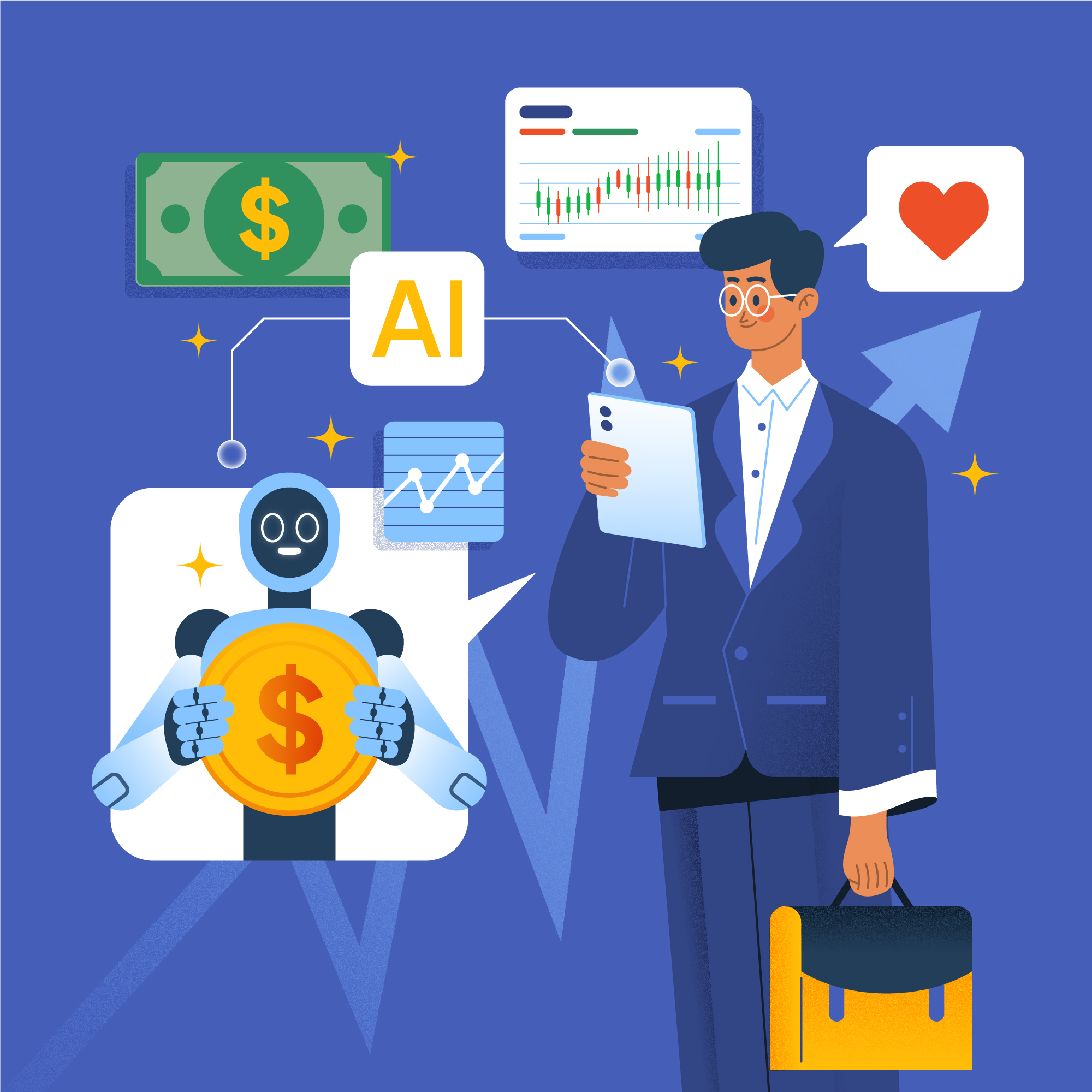
The Impact of AI on Economics is already visible in central banks, research institutions, and financial firms, where machine-driven models now handle much of the heavy data processing that economists used to do by hand, from cleaning enormous datasets to running the first pass of a forecasting model.
Economics has always been a discipline built on data, models, and forecasts, which makes it one of the fields AI was almost certain to reach quickly. What is less obvious is exactly how that contact is playing out: which parts of an economist's work are being absorbed by machines, and which parts are becoming more valuable precisely because they cannot be.
- A Field Built on Data, Now Meeting a Data-Native Technology
- What AI Actually Does Inside Economic Research
- Will There Still Be a Role for the Human Economist?
- The Statistical Backbone That Makes This Work
- A Way to See Where Human Value Sits: The Economic Judgment Ladder
- Benefits of Studying Economics Alongside This Shift
- Trends Currently Shaping This Field
- Roles Open to Economics Graduates in This Environment
- Traditional Versus AI-Augmented Economist Roles
- Bringing It Together
- Frequently Asked Questions
A Field Built on Data, Now Meeting a Data-Native Technology
This is not entirely surprising given how the discipline is structured. Artificial intelligence in economics fits naturally because economic analysis has always depended on large, messy datasets, and AI tools are specifically built to find structure in exactly that kind of data faster than any manual process could.
Zooming out from any single tool, the broader future of economics in the age of AI looks less like a discipline being replaced and more like one being reorganised, with routine forecasting work increasingly automated, and interpretation, policy design, and causal reasoning becoming the parts economists are valued for most.
What AI Actually Does Inside Economic Research
In concrete terms, the most common uses of AI in economic analysis today include demand forecasting, sentiment analysis of financial and news data, fraud and anomaly detection, and rapid scenario modelling across large sets of macroeconomic variables.
What does a modern economics education need to include? This shift has real implications for how the subject is taught. The skills needed for economics graduates today go well beyond classical theory, extending into statistical programming, comfort with large datasets, and enough technical literacy to work alongside, and critically evaluate, AI-generated models.
Where are the jobs actually heading? Hiring patterns reflect this directly. Economics careers in the age of AI increasingly reward candidates who can combine economic theory with applied data skills, rather than treating either one as sufficient on its own.
Will There Still Be a Role for the Human Economist?
It is worth answering this directly rather than dancing around it. The future of economists with AI remains secure precisely because AI is strong at finding correlations in data but still weak at explaining why those correlations exist, or what to actually do about them in a specific policy or business context judgment that remains firmly human.
This is exactly where a structured postgraduate degree earns its value. The core skills learned in MA Economics econometrics, applied statistical modelling, policy analysis, and structured economic reasoning form the foundation that AI fluency is then layered on top of, rather than replacing.
For students who want that foundation built alongside real, applied industry exposure rather than theory alone, it's worth exploring the Online MA Economics Apprenticeship
The Statistical Backbone That Makes This Work
None of this functions without a solid quantitative core. The role of econometrics in AI-assisted economic work remains central, since econometric training is what allows an economist to judge whether an AI model's output is statistically sound or simply an artefact of noisy data.
Concretely, this shows up in daily workflow. How AI is changing economics careers on the ground means less time spent manually building spreadsheets and more time spent reviewing, questioning, and refining AI-generated forecasts before they inform an actual decision.
Given all of this, the direct question of whether MA Economics is relevant in the age of AI has a fairly clear answer: yes, provided the programme itself has evolved to include applied data and AI literacy alongside classical economic theory, rather than teaching the subject exactly as it was taught two decades ago.
To see how a modern economics curriculum is actually structured around this shift, take a look at the full range of AMU Online Courses
Behind nearly every AI application in this space sits the same underlying technique. Machine learning models trained on historical economic and financial data are what actually power the forecasting, classification, and pattern-recognition tools economists now increasingly rely on.
A Way to See Where Human Value Sits: The Economic Judgment Ladder
Rather than treating AI's role in economics as a single blanket statement, it helps to see the work as a ladder of four rungs, with AI doing more of the lifting near the bottom and humans remaining essential near the top.
Data Processing
Cleaning, structuring, and organising raw economic data a task AI now handles with minimal human involvement.
Pattern Recognition
Identifying correlations and trends across large datasets, where AI provides speed and scale beyond manual analysis.
Causal Interpretation
Determining why a pattern exists and whether it reflects a genuine relationship or coincidence a task requiring human economic reasoning alongside AI output.
Policy and Business Judgment
Deciding what to actually do with an insight, weighing trade-offs, context, and consequences that remain firmly a human responsibility.
Benefits of Studying Economics Alongside This Shift
- Access to faster, richer datasets than economists could analyse manually a decade ago
- Ability to test more scenarios and models in the time it once took to build one
- Stronger, more evidence-backed policy and business recommendations
- A widening set of roles that specifically reward the combination of economics and data skills
- Better preparation for research and analyst roles that now assume basic AI tool familiarity
- A meaningful edge over peers trained purely in classical economic theory
- Smoother collaboration with data science and technology teams in mixed working environments
- Long-term career resilience as forecasting and analysis work continues to evolve
Trends Currently Shaping This Field
- Rapid adoption of AI-driven forecasting tools across central banks, financial firms, and research institutions
- Growing overlap between economics, data science, and computer science coursework at the postgraduate level
- Rising demand for economists who can explain and validate AI-generated insights, not just produce them
- Expanding use of AI in policy simulation and real-time economic monitoring
- Economic forecasting increasingly informs real-time business and policy decisions, raising the stakes of getting it right
- Economists who cannot work alongside AI tools risk being sidelined by those who can
- The technical bar for entry-level analyst roles has risen alongside AI adoption
- Strong econometric fundamentals are what keep AI-assisted analysis trustworthy rather than misleading
Roles Open to Economics Graduates in This Environment
Graduates who pair economic theory with applied data and AI literacy commonly move into roles such as:
- Economic Analyst
- Data Economist
- Policy Analyst
- Quantitative Analyst
- Research Economist
- Market Research Analyst
- Risk Analyst
- Business Economist
- Econometrician
- Financial Economist
Traditional Versus AI-Augmented Economist Roles
| Factor | A Traditional Economist Role | An AI-Augmented Economist Role |
|---|---|---|
| Data preparation | Manual cleaning and structuring of datasets | Largely automated, with the economist reviewing rather than building it by hand |
| Model building | Hand-coded statistical and econometric models | AI-assisted model development, with faster iteration across specifications |
| Time to first insight | Days to weeks, depending on dataset size | Hours to days, with AI handling initial pattern discovery |
| Core value added by the economist | Technical modelling skill and domain knowledge | Causal interpretation, policy judgment, and knowing which patterns actually matter |
| Tools centred in daily work | Statistical software and manual coding | Statistical software plus AI-assisted analysis and automation tools |
Bringing It Together
AI is not making economics less relevant; it is making the parts of economics that require genuine judgment more valuable, while automating the parts that were always mechanical. For a student choosing this path today, the strongest position comes from a postgraduate education that treats AI fluency as a natural extension of economic training, not a separate skill bolted on afterwards.