
For students choosing their undergraduate degree and parents helping them make that choice, a BA in History is often viewed with quiet scepticism. The assumption — rarely stated but often present — is that History is a degree for those who love reading but have no plan for employment, that it is intellectually enriching but professionally limiting. That it leads to teaching, if you are lucky, or to nothing in particular if you are not.
That assumption is wrong — not because every History graduate finds easy employment, but because the skills a History degree builds, the career paths it opens, and the professional value it provides are far broader than most people realise. This blog is written to correct that misunderstanding — for students deciding whether to pursue History, and for parents evaluating whether supporting that choice is a sound investment in their child's future.
- What Does the Program Actually Teach: The Intellectual Foundation
- Skills Gained from BA History: What Employers Actually Value
- Job Opportunities: Where History Graduates Actually Work
- Government Jobs After BA History: The Public Sector Pathway
- Career Paths: Journalism, Teaching, Research & Beyond
- After BA History: Which Course Is Better for Your Career?
- What Fresh Graduates Can Realistically Access?
- Is the Program Good for the Future? The Honest Assessment
- Building a Career After BA History: What Actually Works
- Conclusion
- Frequently Asked Questions
What Does the Program Actually Teach: The Intellectual Foundation
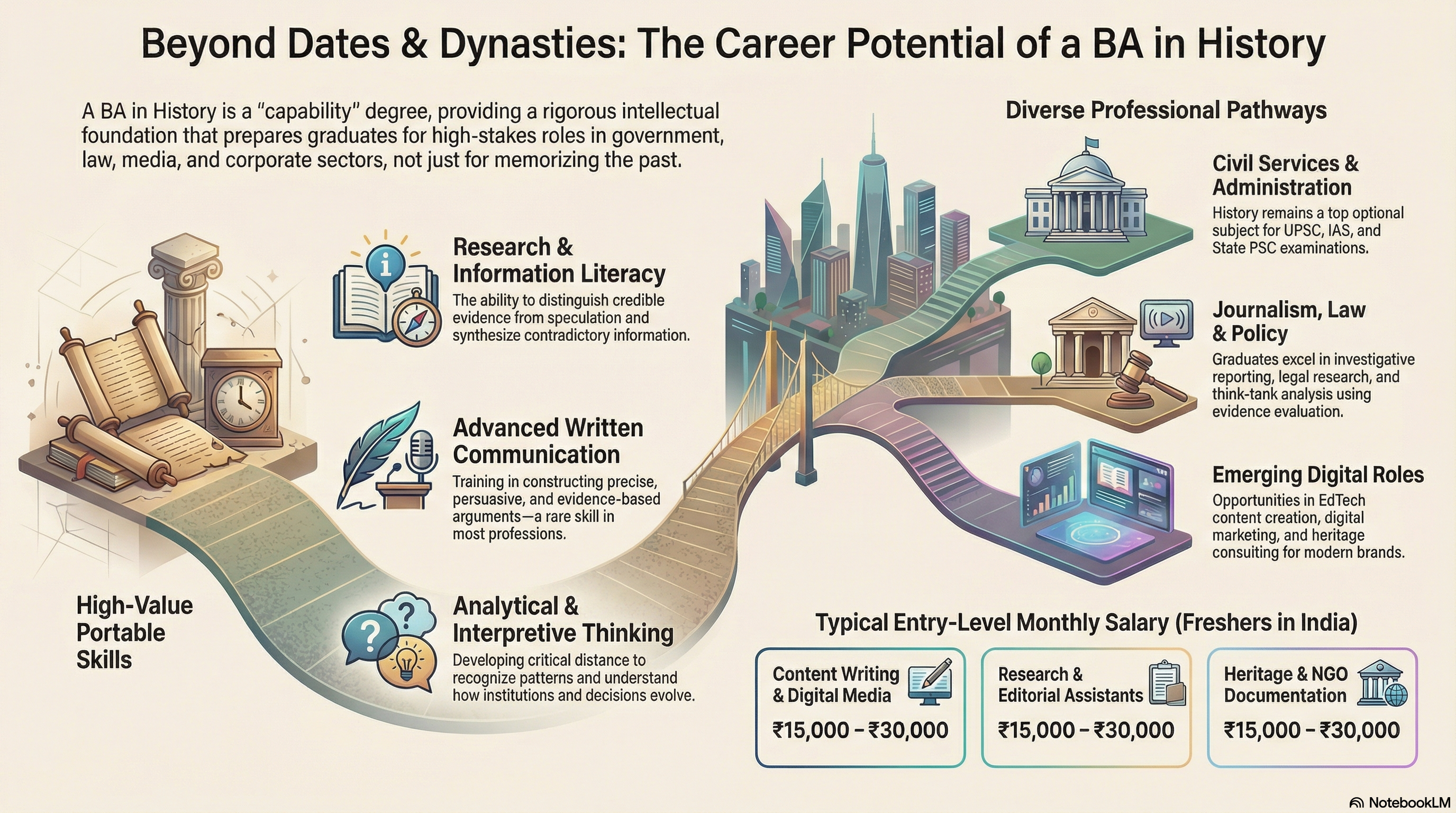
The BA History scope is not what most people think it is. It is not memorising dates and dynasties. A serious History degree — whether pursued at institutions like Aligarh Muslim University , Delhi University, or other recognised universities — is training in how to evaluate evidence, construct arguments, identify bias, understand causation, and communicate complex ideas clearly. These are not History skills. They are cognitive capabilities that transfer to almost any profession that requires thinking, analysis, and communication.
History students learn to work with primary sources — documents, speeches, letters, legal records — and assess their reliability, context, and significance. They learn to synthesise information from multiple, often contradictory sources and construct coherent narratives. They learn to identify how perspective and power shape what gets recorded and what gets forgotten. And they learn to write — extensively, precisely, and persuasively — which is a capability that remains in short supply across most professions.
The intellectual habit that History cultivates is one of critical distance: the capacity to step back from immediate events, recognise patterns, understand how institutions evolve, and see connections between seemingly unrelated developments. In a world where most information is consumed reactively, and most opinions are formed without depth, the ability to think historically — to situate the present within a longer arc and recognise that what feels unprecedented often has precedents — is both rare and valuable.
Foundation principle: The program does not train you for one job — it trains you to think rigorously, research systematically, and communicate effectively. Those are not niche skills. They are the foundation of professional competence in law, journalism, policy, administration, and any field that requires analytical work.
Skills Gained from BA History: What Employers Actually Value
The skills from this program are best understood not as subject knowledge but as intellectual and communicative capabilities that are portable across professional contexts. These are the skills employers look for when hiring graduates who need to analyse information, produce written work, and think independently.
- Research and Information Literacy — The ability to locate, evaluate, and synthesise information from multiple sources. History students become experts at distinguishing credible evidence from speculation, identifying bias, and working with incomplete or contradictory information.
- Critical Reading and Textual Analysis — The capacity to read complex material carefully, extract meaning, identify underlying assumptions, and evaluate arguments.
- Analytical and Interpretive Thinking — The ability to identify patterns, understand causation, and recognise how events and decisions connect across time.
- Written Communication and Argumentation — History students write constantly — essays, research papers, dissertations. They learn to construct arguments, support them with evidence, and present them clearly.
- Contextual Understanding and Perspective-Taking — The ability to understand how people in different times and places thought, what constraints they operated under, and why their decisions made sense within their context.
- Attention to Detail and Accuracy — History demands precision — dates, names, facts, quotations, citations all matter. Students develop a discipline around accuracy that is valuable in any role where errors have consequences.
- Independent Work and Self-Direction — History students spend significant time working independently — reading, researching, writing. They learn to manage long-term projects, meet deadlines without constant supervision, and take intellectual ownership of their work.
For parents: The skills a History degree builds are exactly the skills that distinguish strong candidates in competitive job markets: the ability to think, research, write, and work independently. These are not soft skills — they are the hard skills of knowledge work.
Job Opportunities: Where History Graduates Actually Work
The range of BA History job opportunities is considerably wider than the teaching and museum work that dominate popular perception. History graduates work across sectors — government, media, law, corporate, nonprofit, and education — in roles that require research, analysis, communication, and contextual thinking.
- Civil Services and Administrative Roles — History is one of the most popular optional subjects for UPSC examinations, and many IAS, IFS, and IPS officers hold History degrees.
- Journalism and Media — History graduates work as reporters, editors, researchers, and fact-checkers in print, digital, and broadcast media.
- Law and Legal Research — Many History graduates pursue law degrees (LLB or integrated programmes) and build careers in litigation, corporate law, or legal research.
- Content Writing and Editing — History graduates are consistently employed in content production roles — writing for websites, editing publications, producing educational content, and managing digital media.
- Research and Policy Analysis — Think tanks, research organisations, and policy institutes hire History graduates for research roles that require archival work, literature reviews, and policy analysis.
- Publishing and Editorial Work — Book publishing houses, academic publishers, and journals hire History graduates as editors, manuscript reviewers, and content managers.
- Museum and Heritage Management — Curators, archivists, and heritage managers in museums, archaeological sites, and cultural institutions require History training.
- Tourism and Heritage Consulting — History graduates work in heritage tourism, historical site management, and cultural consulting.
- Corporate Communications and Public Relations — Corporations hire History graduates for roles in corporate communications, brand storytelling, and stakeholder engagement.
- Non-Governmental Organizations and Advocacy — NGOs working on human rights, social justice, education, and cultural preservation hire History graduates for research, documentation, advocacy writing, and programme management roles.
- Education Technology and Content Development — EdTech companies producing history content, educational videos, and digital learning materials hire History graduates as subject matter experts, content creators, and curriculum developers.
- Freelance Research and Consulting — History graduates with strong research skills increasingly work as independent researchers, consultants, or writers.
Employment reality: History graduates do not follow a single career pipeline — they build careers across multiple sectors. The common thread is roles that require research, analysis, and communication. The degree opens doors; what you do once inside depends on the skills you emphasise and the experience you build.
Government Jobs After BA History: The Public Sector Pathway
Government jobs are one of the most reliable and respected career directions for graduates. History is a recognised optional subject for most competitive government examinations, and the degree's training in analytical thinking and essay writing provides strong preparation for these exams.
- UPSC Civil Services (IAS, IFS, IPS) — History is among the most popular optional subjects for the UPSC Civil Services Examination.
- State Public Service Commissions — Every state in India conducts its own PSC examination for recruitment to administrative, revenue, and police services.
- Archaeological Survey of India (ASI) — ASI recruits archaeologists, historians, and conservation officers for roles managing India's heritage sites.
- National Archives and State Archives — Archivists and records managers in national and state archives require History training for cataloguing, preservation, and public access management.
- Indian Council of Historical Research (ICHR) — ICHR and similar research institutions hire historians for research fellowships, documentation projects, and academic positions.
- Ministry of Culture and Tourism — Positions involve heritage management, cultural policy, and tourism development.
- Defence Services and Military History Departments — The armed forces employ historians in their history and heritage wings.
- Public Sector Undertakings (PSUs) in Administration — Large PSUs hire graduates for administrative, documentation, and public relations roles.
- State Information Commissions and Cultural Boards — State-level boards managing cultural affairs, information commissions, and language promotion bodies hire graduates with humanities backgrounds.
Government pathway note: The jobs are highly competitive and require clearing rigorous examinations. The degree provides eligibility and relevant preparation, but employment requires sustained, disciplined exam preparation — typically 1–2 years of focused study beyond graduation.
Career Paths: Journalism, Teaching, Research & Beyond
When students and parents ask about BA History career paths, the conversation often defaults to three traditional directions: journalism, teaching, and research. These remain valid and viable paths — but they deserve to be understood in their current forms, not in outdated versions.
A journalism career after a BA in History is among the most natural transitions for History graduates. The research skills, contextual thinking, and writing proficiency that History builds are exactly what good journalism requires. History graduates work as reporters covering politics, culture, and social issues; as editors shaping coverage; as fact-checkers verifying claims; and as long-form writers producing investigative and narrative journalism.
A teaching career after a BA in History remains a stable and intellectually rewarding path, but it requires clear planning. School teaching positions require a B.Ed. degree after graduation. College and university teaching requires a postgraduate degree (MA History) and, for permanent positions, clearing the UGC NET examination or equivalent.
Research careers in history typically require postgraduate and doctoral qualifications. Professional historians work in universities, research institutes, think tanks, and independent consulting. The work involves archival research, writing books and articles, contributing to policy debates, and producing historically informed analysis of contemporary issues.
Career paths principle: Journalism, teaching, and research are credible paths for History graduates — but none of them is simple or automatic. Each requires additional qualification, skill development, and sustained effort beyond the undergraduate degree. Treat them as directions to pursue deliberately, not defaults to fall into.
After BA History: Which Course Is Better for Your Career?
The question of which course is better depends entirely on the career direction you are pursuing. There is no universal best choice — only choices that align with specific professional goals.
For students targeting civil services or academic careers, an MA in History is the most direct next step. It deepens subject expertise, provides research training, and is often required for teaching positions and doctoral programmes. The MA also strengthens preparation for competitive exams where History is an optional subject.
For students interested in law, a three-year LLB or a five-year integrated BA LLB (for those planning ahead from school) is the standard pathway. History graduates do well in law school because their analytical and writing skills are directly transferable. Law opens careers in litigation, corporate practice, public interest law, and legal academia.
For students drawn to journalism or media, a postgraduate diploma or MA in Journalism and Mass Communication provides structured training in reporting, editing, broadcast, and digital media. Some History graduates enter journalism directly through a BA History Online Internship or freelance work, but formal journalism training accelerates the entry and provides professional networks.
For students interested in policy, governance, or international relations, an MA in Political Science, Public Policy, or International Relations builds on the analytical foundation that history provides while adding policy-specific skills. This pathway is common for History graduates moving into think tanks, NGOs, and international organisations.
For students targeting corporate careers or management roles, an MBA after a few years of work experience is a viable option. History graduates with strong analytical and communication skills compete successfully in MBA programmes and in subsequent management careers — though this path requires work experience and is not an immediate post-graduation choice.
For students interested in education, a B.Ed. (Bachelor of Education) is required for school teaching. Some universities, including prominent institutions, offer integrated BA B.Ed. programmes that combine the History degree with a teaching qualification in four years, which is an efficient pathway for those certain about teaching careers.
Course selection principle : The best course after BA History is the one that serves your career goal, not the one that feels safest or most familiar. If you know what you want to do, choose the qualification that gets you there. If you do not yet know, an MA in History keeps the most doors open while you decide.
What Fresh Graduates Can Realistically Access?
The practical question for most students and parents is: what after BA History jobs are available immediately after graduation, before additional qualifications or competitive exam success?
The honest answer is that the program, like most undergraduate humanities degrees, does not directly credential you for a specific profession in the way that an engineering or medical degree does. The jobs available immediately after graduation are typically entry-level positions that value general intellectual capability, writing skills, and the ability to learn quickly.
- Content writing roles for websites, digital marketing agencies, and media companies
- Editorial assistant and proofreading positions in publishing houses
- Research assistant roles in think tanks, NGOs, and consulting firms
- Junior positions in museums, archives, and heritage organizations
- Entry-level administrative roles in education institutions and cultural organizations
- Freelance writing or research work for clients who need historical content, fact-checking, or documentation support
The salaries for these entry-level roles typically range from ₹15,000 to ₹30,000 per month — modest by any measure, but comparable to what most fresh humanities graduates earn at the entry level. These roles are best understood as professional entry points — places where you build experience, demonstrate capability, and identify what kind of work you want to pursue at higher levels — rather than as career destinations in themselves.
Entry-level reality: Immediate jobs after an undergraduate program are not glamorous or high-paying — but they are pathways. The graduates who treat them as learning opportunities, build skills, and move strategically into better roles over 2–3 years fare well. Those who expect the degree alone to deliver a career without further effort do not.
Is the Program Good for the Future? The Honest Assessment
The question that parents and students most want answered is: Is BA History a sound choice for a career in 2026 and beyond? The answer is conditional — yes, but only under specific circumstances.
This program is a good choice if you are genuinely interested in the discipline, willing to read extensively, capable of independent work, and prepared to build a career that requires thought and communication rather than technical execution. It is a good choice if you are considering careers in civil services, law, journalism, research, teaching, or policy — all of which value the analytical and communicative skills History develops.
It is a less sound choice if you are choosing it by default, if you are not prepared to invest in further qualifications after graduation, if you need immediate high income upon finishing your degree, or if you are hoping that the degree alone will deliver employment without significant additional effort. History is not a vocational degree — it is an intellectual training that becomes professionally valuable when paired with a clear career direction and supplementary skills.
The future value of a History degree depends less on the job market and more on what you bring to it. The cognitive skills History builds — research, analysis, argumentation, writing — remain in demand. But those skills need to be demonstrated, not just claimed. A History graduate with a strong portfolio of written work, research experience, and clear professional direction will build a strong career. One who completes the degree passively and waits for opportunities to appear will struggle.
For students and parents: Any undergraduate program is not a guarantee of anything. What it provides is intellectual training that transfers to multiple careers, provided you use it deliberately. If that sounds uncertain, it is because it is. Certainty is not what humanities degrees offer. Capability is.
Building a Career After BA History: What Actually Works
For students who have decided to pursue a BA in History, or parents supporting that choice, the practical question is: what should the student be doing during and immediately after the degree to maximise career outcomes?
- Read widely and write regularly. History is a reading-intensive discipline, and the students who engage deeply with the material — not just for exams, but for understanding — develop stronger analytical and communicative skills. Writing should extend beyond coursework: maintaining a blog, contributing articles to campus publications, or writing research papers for conferences all build a portfolio that demonstrates capability.
- Pursue internships and research assistant positions during undergraduate years. Museums, archives, NGOs, think tanks, and media organisations offer internships that provide professional exposure and references. These experiences are what differentiate competitive candidates in entry-level hiring.
- Develop supplementary skills that make you more employable. Basic digital literacy, data analysis in Excel or Google Sheets, content management systems, and even introductory coding or design skills broaden the range of roles you can compete for.
- Build a professional network. Attend seminars, conferences, and public lectures. Connect with faculty members who work on topics you are interested in. Join student organisations focused on journalism, policy, or social issues. Professional networks are how most opportunities in humanities careers are accessed.
- Prepare for competitive exams if that is your intended pathway. Civil services, state PSC, and other government examinations require sustained preparation — typically beginning in the second or third year of your undergraduate programme. Treat exam preparation as part of your degree plan, not something to start after graduation.
Career-building principle: The program provides the foundation. What you build on that foundation — through internships, writing, skill development, and networking — is what determines career outcomes. The degree is necessary but not sufficient. The initiative is what converts potential into employment.
Conclusion
For students drawn to understanding how the world came to be the way it is, how power has been exercised and contested, and how societies change over time, History is the discipline that addresses those questions with rigour.
For parents evaluating whether to support that choice, the confidence should come not from guarantees of employment — which no degree provides anymore — but from the recognition that the skills History builds are exactly the skills that knowledge work demands: the ability to think, research, write, and work independently. If your child has those capabilities and is willing to use them deliberately, the career will follow.