
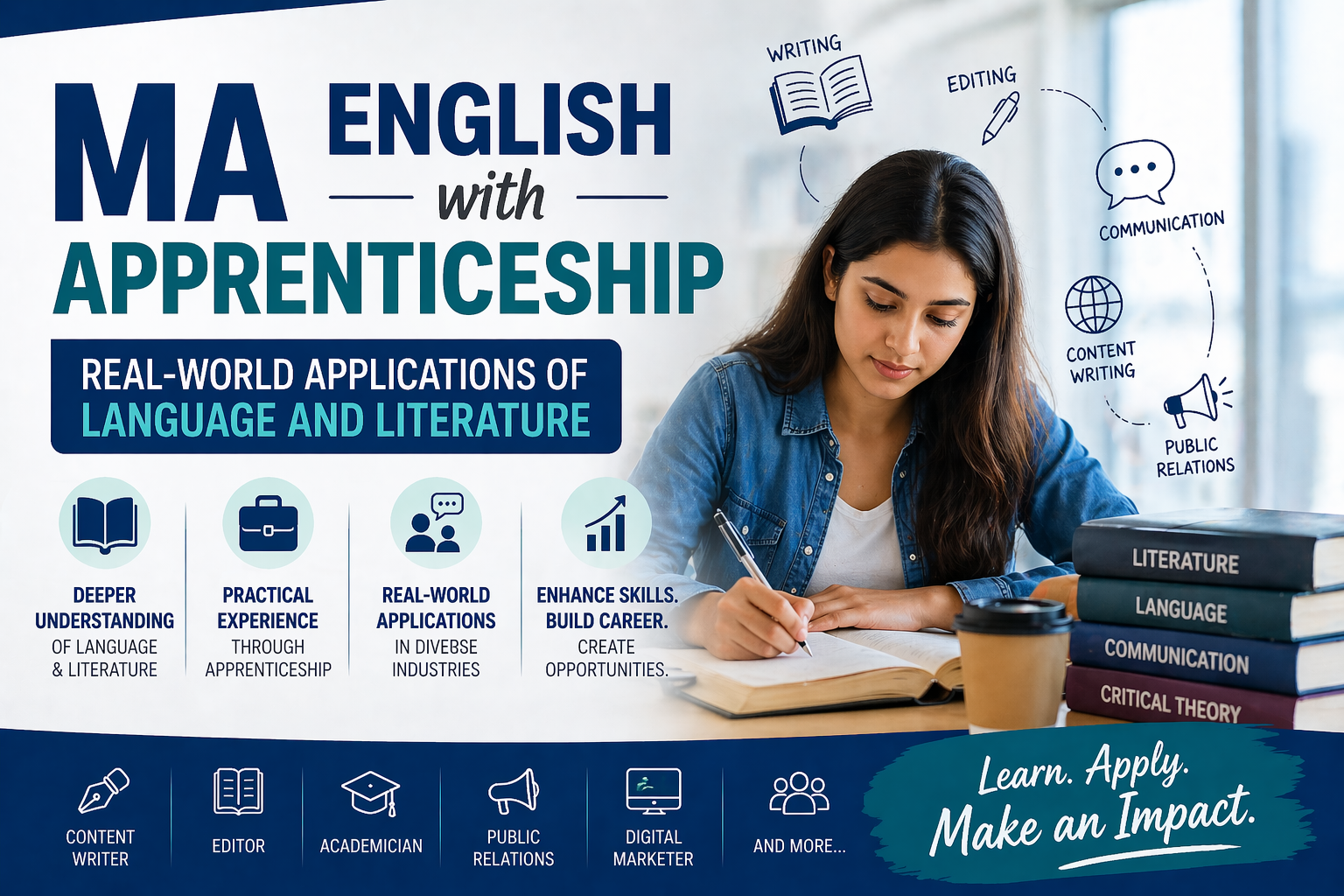
The question about an English degree has never really been about intelligence or love of literature. It has always been about what happens after. This blog answers that question with specificity.
There is a persistent and damaging narrative around humanities degrees in India that goes something like this: literature is for those who could not get into engineering or medicine, the degree has no practical application, and the career options are limited to teaching or civil services. Students who are genuinely drawn to language, critical thinking, and literary study have been internalising this narrative for decades often choosing programmes they are less suited for, because the cultural pressure to choose ‘practical’ education is stronger than their own intellectual instincts.
That narrative was always incomplete. In 2026, it is also increasingly inaccurate. The industries that are growing fastest in the Indian economy, digital media, content marketing, edtech, publishing technology, UX writing, corporate communications, and legal services, are actively hiring people who can read and write with precision, think critically across contexts, and communicate complex ideas to diverse audiences. These are not incidental benefits of an English degree. They are the core outputs of a well-designed programme, and they are in short supply.
The question worth asking in 2026 is not whether an English degree is practical. It is whether the specific programme being considered is designed to translate its academic rigour into demonstrable professional capability. That is what the apprenticeship model is designed to ensure, and that is what this blog examines.
- What the Market Is Actually Asking For
- What the Programme Is and How It Is Built
- Should You Choose This Programme? The Decision Framework
- How the Programme Translates Academic Study Into Professional Capability
- What You Actually Study and What Skills It Builds
- The Skill Set That the Programme Builds: In Detail
- How the Apprenticeship Changes the Career Outcome
- Career Scope: Where an MA in English with Apprenticeship Actually Takes You
- The Online Delivery Advantage: Apprenticeship Without Geographic Constraint
- Applications of a Language Degree That Most Students Underestimate
- Is the Programme Worth It? The Evidence-Based Answer
- Where the Demand for These Skills Is Going
- Key Takeaways
- FAQs
What the Market Is Actually Asking For
What is MA English with apprenticeship program? The hiring signal from content-intensive industries is consistent and growing louder: they want graduates who can write not just grammatically, but persuasively, precisely, and for specific audiences. They want people who can analyse a text, a brief, a dataset, or a conversation and extract what matters. They want communicators who can translate complexity into clarity. These are not soft skills. They are high-value professional capabilities, and they are precisely what a rigorous English postgraduate programme develops.
The distinction that the apprenticeship model addresses is the gap between developing these capabilities in an academic context and demonstrating them in a professional one. An MA graduate who has only ever written essays for faculty evaluation is a different candidate from one who has written for a publishing house, a media organisation, or a corporate communications team under real deadlines, for real audiences, with real feedback.
The hidden implication: the industries that most value the capabilities an English degree builds, content, media, education, legal, and corporate communications, are also the industries most likely to filter at the interview stage for evidence of applied experience. A portfolio of professional work, built during the degree through a structured apprenticeship, is the credential that converts academic capability into hiring credibility.
What the Programme Is and How It Is Built
The MA English syllabus and structure in a well-designed apprenticeship-integrated programme operate across two parallel tracks that reinforce each other throughout the two years of study. The first is the academic track: literary theory, critical analysis, linguistics, translation studies, creative writing, and research methodology. The second is the applied track: the apprenticeship placement, structured professional projects, and portfolio development.
The academic track is not diluted to make room for the applied one. The critical and analytical depth that defines postgraduate English study remains intact, the theoretical frameworks, the close reading methods, and the research skills. What changes is the application context: students are asked not only to analyse a text in an essay but to apply that analytical capability to a professional brief, a content strategy, a translation project, or an editorial assignment. The academic and applied tracks are designed to illuminate each other.
Understanding how apprenticeship works in MA English requires distinguishing it from a conventional internship. An internship is typically a short, standalone placement that happens alongside or after the academic programme. An apprenticeship, in the integrated model, is a structured, assessed professional engagement that runs concurrently with academic study with faculty involvement, defined learning outcomes, and formal evaluation. The organisation hosting the apprentice is a partner in the learning process, not just a placement venue.
Should You Choose This Programme? The Decision Framework
Should I choose MA English or an apprenticeship model is one that deserves a direct answer rather than a diplomatic one. The right choice varies for a specific kind of student, and understanding whether that description fits you is more valuable than any ranking or reputation assessment.
Who is genuinely well-suited:
- Students who are drawn to language, literature, and critical thinking as intellectual pursuits, not as fallback options and who want a postgraduate degree that builds on that foundation with professional rigour
- Those who want to enter content-intensive industries, such as publishing, media, content marketing, corporate communications, edtech, UX writing, and legal drafting and understand that a portfolio of professional work is the entry credential that those industries value most
- Graduates who found their undergraduate English or humanities study intellectually engaging but felt the academic context was too removed from professional application, and want a programme that deliberately bridges that gap
- Students who are self-directed and prepared to manage both academic rigour and professional commitments simultaneously, because the apprenticeship model requires both at the same time
Who should think carefully before choosing:
- Students who are choosing the programme because they want to continue in academia and pursue a PhD immediately after the apprenticeship model builds professional capability, and while it does not prevent academic continuation, its primary orientation is toward applied careers
- Those who are looking for a light postgraduate credential without a substantive academic or professional commitment, the integrated model is demanding on both dimensions
- Students who have not yet identified any professional domain where their English skills would apply, the apprenticeship component works best when there is a directional interest, even a rough one, to anchor the placement
What happens when the fit question is skipped?
A common pattern: students who enter the programme without genuine engagement with either the academic content or the applied component produce weak academic work and weak portfolio pieces, and graduate with a credential that neither the academic nor the professional market takes seriously. The programme's value is concentrated at the intersection of intellectual rigour and professional application. Disengaging from either dimension halves the return.
How the Programme Translates Academic Study Into Professional Capability
The MA English course with practical training is built on a premise that most conventional MA English programmes do not articulate clearly: that the skills developed through literary and linguistic study are not merely academic. They are the foundation of every content-intensive profession. Critical reading is the foundation of editorial work. Argument construction is the foundation of legal and policy writing. Narrative analysis is the foundation of screenwriting and brand storytelling. Linguistic precision is the foundation of UX writing and technical communication.
The programme's design makes these translations explicit rather than leaving them implicit. Students do not just study rhetorical theory; they write persuasive content for a real audience. They do not just analyse narrative structure; they apply it to develop a content series for a media partner. They do not just read translation theory; they translate a document for a client organisation. The applied components are calibrated to the academic ones, creating a coherent progression from theoretical understanding to professional capability.
The career translation logic: literary and linguistic study builds critical and analytical capability —→ applied projects build professional craft —→ apprenticeship builds industry context and portfolio —→ credential plus portfolio builds hiring credibility. Each stage feeds the next, and removing any one of them breaks the chain.
What You Actually Study and What Skills It Builds
The practical training in MA English component is most valuable when it is understood as part of a broader skill architecture, not as a standalone credential add-on. Here is how the academic and applied components map to the skills that hiring managers in content-intensive industries are looking for.
| Academic Module | Skills Developed | Professional Application |
|---|---|---|
| Literary Theory and Criticism | Analytical frameworks, critical argument construction, interpretive precision | Editorial analysis, content strategy, literary journalism, cultural criticism |
| Linguistics and Language Studies | Grammar at depth, discourse analysis, register awareness, language variation | UX writing, technical documentation, copy editing, and language policy roles |
| Creative Writing | Narrative construction, voice development, genre awareness, and revision discipline | Content creation, screenwriting, brand storytelling, publishing |
| Translation Studies | Cross-linguistic precision, cultural mediation, and source text fidelity | Literary translation, localisation, international communications, subtitling |
| Research Methodology | Primary and secondary research, citation integrity, and evidence-based argument | Journalism, policy writing, academic publishing, and content research |
| Digital Humanities | Digital text analysis, corpus tools, content management, and digital publishing | Content technology, digital media, e-publishing, SEO content |
| Drama and Performance Studies | Dialogue writing, character analysis, performance narrative | Scriptwriting, corporate training content, and podcast production |
| Comparative Literature | Cross-cultural analysis, multi-text synthesis, global literary contexts | International publishing, cultural journalism, and global communications roles |
The Skill Set That the Programme Builds: In Detail
The question of what skills are developed in MA English is best answered by separating the skills into three categories: foundational capabilities that apply across all professional contexts, domain-specific capabilities that apply to specific industry tracks, and the professional behaviours that the apprenticeship component develops through applied experience.
| Skill Category | Specific Skills | Where Valued in the Job Market |
|---|---|---|
| Foundational (all contexts) | Precise written communication, critical argument construction, close reading and textual analysis, research and synthesis, editing and revision | Every organisation that produces written output, which is effectively every organisation of consequence |
| Content and media | Content strategy, SEO writing, editorial planning, narrative development, audience analysis, brand voice development | Digital media companies, D2C brands, content agencies, news organisations, publishing houses |
| Communication and corporate | Business writing, stakeholder communication, report and proposal writing, presentation development, internal communications | Consulting firms, corporates, NGOs, government communications, PR agencies |
| Education and training | Curriculum writing, instructional design, educational content development, assessment writing | Edtech companies, coaching institutes, corporate L&D functions, schools and universities |
| Legal and policy | Precise drafting, regulatory language, policy analysis, legal document review, plain language translation of complex text | Law firms, regulatory bodies, policy organisations, compliance functions |
| Professional behaviours (from apprenticeship) | Deadline management, client brief response, professional feedback reception, iterative revision under direction, and workplace communication | Every employer, these are the behaviours that distinguish a hireable graduate from a capable student |
Understanding skills gained in MA English program through this framework makes it clear that the degree's professional value is not confined to obvious language roles. It extends to any function that requires clear thinking, expressed clearly in writing, which covers a significantly larger share of the professional world than the ‘English degree leads to teaching’ narrative suggests.
How the Apprenticeship Changes the Career Outcome
The question of how practical training helps English students is answered most clearly by comparing two graduates from the same academic programme, one with an apprenticeship component and one without.
The graduate without apprenticeship experience enters the job market with strong analytical and writing skills, demonstrated through academic work that hiring managers typically cannot read. Their CV lists degree grades, dissertation topics, and module names, none of which directly answer the employer's question: can you do this specific kind of work, under these conditions, for this kind of organisation? The answer may be yes, but it is not demonstrable. The hiring manager takes a risk.
The graduate with an integrated apprenticeship enters with a portfolio: published content, edited manuscripts, translated documents, communications campaigns, or research reports produced for real organisations under real professional conditions. Their CV answers the employer's question directly and visibly. The hiring manager takes a fact-based decision rather than a risk-based one. The conversion rate from interview to offer for the second profile is consistently higher, and so is the quality of the offer.
Career Scope: Where an MA in English with Apprenticeship Actually Takes You
The MA English career scope with internship is significantly broader than the conventional perception of English degree careers. The combination of academic rigour and demonstrated professional experience opens pathways across multiple high-growth industries.
| Career Track | Specific Roles | Key Industries | Starting Salary Range |
|---|---|---|---|
| Content and Digital Media | Content Writer, Content Strategist, SEO Content Manager, Digital Editor, Social Media Manager | Digital agencies, D2C brands, media companies, news platforms | Rs. 3.5–7 LPA |
| Publishing and Editorial | Editorial Assistant, Copy Editor, Commissioning Editor, Literary Agent, Publishing Manager | Book publishers, academic journals, e-publishing platforms | Rs. 3–6 LPA |
| Corporate Communications | Communications Executive, Internal Communications Lead, PR Executive, Brand Content Manager | Large corporates, consulting firms, NGOs, government communications | Rs. 4–8 LPA |
| Education and EdTech | Curriculum Developer, Instructional Designer, Content Developer, Academic Writer, Training Manager | EdTech companies, coaching institutes, schools, and corporate L&D | Rs. 3.5–6.5 LPA |
| UX Writing and Technical Communication | UX Writer, Technical Writer, Documentation Specialist, Product Content Designer | Technology companies, SaaS firms, product startups | Rs. 5–10 LPA |
| Legal and Policy Writing | Legal Writer, Policy Analyst, Regulatory Communications, Compliance Content Specialist | Law firms, policy organisations, regulatory bodies, government | Rs. 4–8 LPA |
| Translation and Localisation | Literary Translator, Localisation Specialist, Subtitler, Language Consultant | Publishing, OTT platforms, international organisations, NGOs | Rs. 3.5–7 LPA |
| Media and Journalism | Reporter, Features Writer, Researcher, Script Writer, Podcast Producer | News organisations, OTT content studios, documentary production | Rs. 3–6 LPA |
The UX Writing and Technical Communication track is worth highlighting, specifically, it is one of the fastest-growing and best-compensated entry points for English graduates, and it is one where the combination of linguistic precision and digital familiarity that a well-designed programme builds is directly valued. Technology companies actively seek writers who understand both language and product, and the supply of graduates with that combination is genuinely constrained.
The Online Delivery Advantage: Apprenticeship Without Geographic Constraint
One of the practical advantages of an online MA internship program model is that the apprenticeship component is not geographically constrained. A student based in a smaller city can complete a professional placement with a publishing house in Mumbai, a content agency in Bengaluru, or an international NGO with a remote work policy without relocating. This geographic flexibility significantly expands the range and quality of apprenticeship placements available to students outside metro areas.
The online delivery format also produces a specific kind of professional preparation that is increasingly relevant: the ability to work effectively in distributed, digital-first professional environments. Content creation, editorial work, communications, and UX writing are all fields where remote and hybrid work is now the norm rather than the exception. A student who has completed an apprenticeship through an online programme has already demonstrated the ability to manage professional deliverables in exactly this kind of environment, which is a hiring signal that employers in these fields find genuinely valuable.
Applications of a Language Degree That Most Students Underestimate
The question of real world applications of an English degree is one that most students and families ask with a degree of scepticism, as if the answer will be thin or defensive. It is neither. The applications are wide, specific, and growing.
In the technology sector, every software product needs documentation, help content, onboarding copy, and in-app writing that guides users through complex processes. UX writers, technical writers, and product content designers are roles that technology companies actively recruit for, and the supply of graduates with genuine linguistic precision and the adaptability to learn product context is limited.
In the media and entertainment sector, OTT platforms, podcast networks, and digital media companies have created an unprecedented volume of demand for writers who can develop original content across formats. The ability to construct a narrative, develop a character, and adapt voice for different platforms is the core requirement for these roles.
In the corporate sector, as Indian companies expand internationally and digital communication becomes the primary mode of stakeholder engagement, the demand for professionals who can write clearly for diverse audiences, annual reports, investor communications, employee engagement content, and regulatory filings continues to grow. These are not junior roles. At senior levels, corporate communications is a strategic function, and the career ceiling is high.
Is the Programme Worth It? The Evidence-Based Answer
The question of whether MA English with apprenticeship is worth it is best answered by measuring it against the specific outcome the student is trying to achieve, not against a generic assessment of whether humanities degrees are valuable.
For a student who wants to enter a content-intensive industry, has genuine intellectual engagement with language and literature, and is prepared to engage fully with both the academic and apprenticeship components, yes, with clear evidence. The combination of postgraduate academic credibility and demonstrated professional experience is the profile that those industries are looking for and finding difficult to hire at the entry level. The degree produces exactly what the market is short of.
The honest qualification: the return on the programme is directly proportional to the quality of the apprenticeship placement and the depth of the student's engagement with it. A weak placement at a low-quality organisation, or a strong placement treated as a formality, produces a weak portfolio and a limited career advantage. The institutional infrastructure behind the apprenticeship, how placements are sourced, how they are mentored, and how the work is assessed, is the critical variable in evaluating any specific programme.
Where the Demand for These Skills Is Going
More specifically, the growth of India's content economy OTT platforms, digital publishing, branded content, and edtech is creating sustained demand for writers and editors who combine cultural depth with professional craft. The internationalisation of Indian content, Bollywood, publishing, and gaming entering global markets, is creating new demand for translation, localisation, and cross-cultural communication. And the continued expansion of India's technology sector is maintaining strong demand for UX writers, technical communicators, and product content professionals. Each of these trajectories favours the graduate who enters with both academic rigour and applied experience.
Key Takeaways
- The MA English with Apprenticeship is a programme designed for students who want to convert genuine academic capability in language and literature into demonstrable professional skill, not as a shortcut, but as a structured transition.
- The apprenticeship component is the differentiator. It transforms the degree from an academic qualification into a qualification plus portfolio, and the portfolio is what converts academic capability into hiring credibility.
- The career paths available are wider than the conventional narrative suggests: content, media, corporate communications, edtech, UX writing, legal writing, publishing, and translation.
- The UX writing and technical communication track is the fastest-growing and best-compensated entry point in the technology sector.
- AI is increasing the value of skilled human judgment in language, not diminishing it. The programme builds exactly the capabilities that are becoming scarcer.
FAQs
📞 Ready to Advance Your Career with MA English?
Reach out to the Aligarh Muslim University admissions team directly for programme details, eligibility, and application guidance.
Enquire NowWant to know more about the MA English with Apprenticeship? Reach out to the Aligarh Muslim University admissions team directly for programme details, eligibility, and application guidance.