
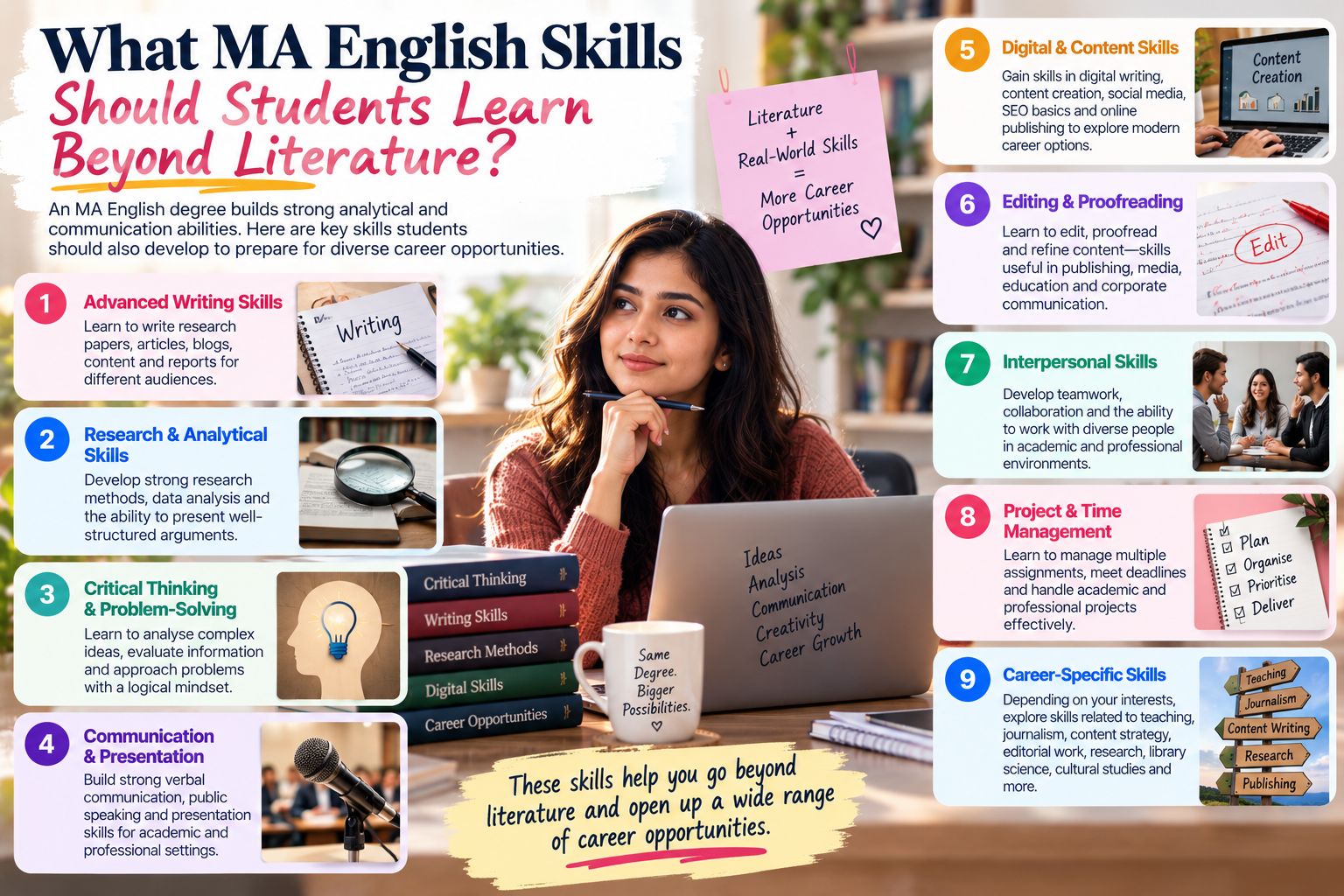
English postgraduates who combine literary depth with editing, digital content, research, teaching methods and responsible use of AI tools are the ones best placed for today’s workplace. Literary study builds close reading, interpretation and argument; adding practical, industry-facing capabilities turns those strengths into employable expertise.
A successful career after MA English increasingly depends on this combination. Employers in media, publishing, education, corporate communication and technology value the ability to write clearly and think critically, but they also expect graduates to work with digital platforms, meet editorial standards and adapt writing for different audiences.
This guide explains what the discipline covers beyond literature, which additional capabilities matter most, how to build them, which roles they lead to and how a work-integrated postgraduate programme can support the transition from classroom to career.
- How the Market for Language Skills Is Changing
- What the Discipline Covers Beyond the Literary Canon
- The PRISM Model: Five Skill Areas Beyond Literature
- Core Capabilities to Develop During the Programme
- Digital Fluency and Responsible Use of AI
- Literature Training vs Workplace Expectations
- Career Paths and Job Roles
- Building Skills Through Study and Apprenticeship
- Planning the Next Step
- Frequently Asked Questions
How the Market for Language Skills Is Changing
Demand for skilled writers, editors and communicators has not disappeared; it has moved to new formats and platforms. Several developments explain the shift.
Trends reshaping English-related careers
- Digital media now leads the industry: the latest FICCI–EY media and entertainment report shows digital media crossing ₹1 lakh crore to become the largest segment, growing about 30% in a year (Storyboard18).
- Content roles are multiplying: Indeed data shows job postings for content-creation roles in India rose 919% between 2020 and early 2026, with storytelling named among the key skills employers seek (HRKatha).
- Regional and multilingual content dominates: regional-language content makes up 56% of digital content produced in India, creating demand for translators, bilingual writers and localisation editors.
- AI is changing how text is produced: generative AI tools now draft routine content, raising the value of professionals who can edit, fact-check, adapt tone and ensure accuracy.
- Communication remains a top hiring priority: employer surveys such as the GMAC Corporate Recruiters Survey continue to rank communication among the most valued workplace skills.
These trends broaden MA English job opportunities well beyond teaching and journalism. Language expertise is now needed in marketing, technology, education technology, publishing, public relations and research.
What the Discipline Covers Beyond the Literary Canon
A postgraduate programme in English typically extends beyond the study of poetry, drama and fiction into several related areas. Understanding these areas helps students see the wider skill base they are already building.
Key areas beyond literature
- Literary theory and criticism: frameworks such as structuralism, Marxism, feminism, postcolonialism and psychoanalysis that explain how texts produce meaning.
- English Language Teaching (ELT): methods for teaching English as a second language, including curriculum design, classroom techniques and assessment.
- World and Indian literatures: comparative study across cultures, including Indian Writing in English, which builds cultural and contextual awareness.
- Language and linguistics: in many programmes, the study of phonetics, grammar, syntax and language use in society.
- Research and academic writing: framing arguments, reviewing scholarship, citing sources and writing dissertations or viva presentations.
These components develop transferable abilities that employers value: analysis, argument, cultural insight, structured writing and the confidence to present ideas.
The PRISM Model: Five Skill Areas Beyond Literature
The PRISM Model is an original framework that organises the capabilities English postgraduates should build alongside literary study into five areas. Like a prism splitting light, it shows how a single foundation in language separates into several distinct career strengths.
| Skill area | What it involves | Tools and practices | Career outcome |
|---|---|---|---|
| P – Publishing and editing | Copy-editing, proofreading, structural editing and style guides | Chicago or APA style, track changes, editorial workflows | Editor, proofreader, publishing assistant |
| R – Research and analysis | Gathering, evaluating and synthesising information | Academic databases, citation tools, reference management | Research associate, content researcher |
| I – Instruction and communication | Teaching, training and presenting ideas clearly | ELT methods, lesson planning, presentation tools | Lecturer, trainer, corporate communication specialist |
| S – Storytelling for digital media | Writing for web, social media, video and audio | SEO basics, content management systems, analytics | Content writer, copywriter, social media executive |
| M – Machine collaboration | Using AI tools responsibly to draft, check and refine text | Prompting, fact-checking, editing AI output, ethics | AI content editor, content quality specialist |
The model’s central idea is that literary training is the light source and each skill area is a direction it can take. A student does not need all five equally; developing two or three in depth, aligned with a chosen career, is usually more valuable than a shallow familiarity with all of them.
Benefits of building beyond literature
- It widens the range of roles a graduate can apply for.
- It makes literary training visible to employers through practical outputs.
- It reduces dependence on a small number of traditional academic posts.
- It prepares graduates for hybrid roles that combine writing, technology and strategy.
Core Capabilities to Develop During the Programme
The most valuable skills for MA English students are those that turn reading and writing strengths into practical workplace capability. The following list sets out where to focus.
- Writing for different audiences: adapting tone, length and structure for academic, corporate, marketing and digital readers.
- Editing and proofreading: applying style guides, checking consistency and improving clarity in other people’s writing.
- Research and fact-checking: verifying claims, citing sources accurately and distinguishing reliable from unreliable information.
- Presentation and public speaking: explaining ideas confidently in seminars, interviews and meetings.
- Teaching and training: planning lessons and explaining language concepts, supported by ELT methods.
- Translation and bilingual writing: working between English and an Indian language for localisation and publishing.
- Project and deadline management: handling multiple writing or editorial tasks to schedule.
These abilities also form the core employability skills for English graduates, because they apply across sectors. Recruiters in education, media and business consistently look for clear communication, attention to detail and the ability to work with feedback.
Digital Fluency and Responsible Use of AI
Most writing jobs are now performed online, so pairing an MA English and digital skills profile has become a practical necessity rather than an optional extra. Basic digital competence makes literary expertise usable in modern content teams.
Digital capabilities worth learning
- Content management systems: publishing and formatting content on platforms such as WordPress.
- SEO writing basics: understanding keywords, headings and readability so content can be found in search.
- Social media writing: crafting short-form posts and captions suited to each platform.
- Basic analytics: reading page views, engagement and conversion data to improve content.
- Collaboration tools: shared documents, version control and editorial workflow tools.
- Visual and audio basics: simple design tools and scripting for video or podcasts.
Developing AI content skills for English graduates means learning to use generative AI as an assistant rather than a replacement. Strong practitioners write precise prompts, critically edit AI drafts for accuracy, tone and originality, check facts and citations, and understand the ethical issues of plagiarism, bias and disclosure.
The combination of human judgement with machine speed defines the future skills for English graduates. As AI handles routine drafting, the scarce capabilities are editorial judgement, cultural nuance, originality and the ability to verify information, all of which literary training develops naturally.
Literature Training vs Workplace Expectations
The comparison below shows how strengths built through literary study map to what employers expect, and what additional skill bridges the gap.
| Strength from literary study | Workplace expectation | Bridging skill to add |
|---|---|---|
| Close reading of texts | Accurate editing and quality control | Copy-editing and style guide use |
| Long-form critical essays | Concise, audience-focused writing | Business, web and SEO writing |
| Theoretical analysis | Evidence-based recommendations | Research and data interpretation basics |
| Seminar discussion | Confident presentations and client communication | Presentation and public speaking practice |
| Knowledge of literary history | Content that connects with current audiences | Digital storytelling and trend awareness |
| Individual study | Team-based, deadline-driven work | Collaboration tools and project management |
Career Paths and Job Roles
The range of MA English jobs now spans education, media, publishing, corporate communication, technology and the public sector. The table below lists common roles by sector.
| Sector | Job roles |
|---|---|
| Education | Lecturer or assistant professor (after UGC-NET), school teacher, ELT trainer, academic content developer, communication skills trainer |
| Media and journalism | Journalist, media correspondent, sub-editor, news writer, podcast scriptwriter |
| Publishing | Editor, copy editor, proofreader, commissioning assistant, rights and acquisitions assistant |
| Content and marketing | Content writer, copywriter, content strategist, social media manager, brand storyteller |
| Corporate sector | Corporate communication specialist, public relations executive, internal communications manager, technical writer |
| Technology and AI | AI content editor, UX writer, localisation specialist, content quality analyst |
| Research and public sector | Research associate, translator, documentation officer, civil services and government examination aspirant |
Among the career options after MA English, teaching remains a stable route, while content, communication and technology roles offer faster growth in the private sector. Many graduates combine paths, for example, teaching while freelancing as editors or writers.
Interest in publishing careers after MA English is supported by the growth of digital and regional-language publishing, e-books, audiobooks and educational content. Entry typically begins with proofreading or editorial assistance, progressing to editor and commissioning roles with experience.
Advantages of a broad English skill set
- Sector flexibility: language skills are needed in almost every industry.
- Freelance potential: writing, editing and translation can be pursued independently.
- Resilience: human judgement in editing and communication remains difficult to automate.
- Academic pathway: strong research skills support UGC-NET, PhD and teaching careers.
Building Skills Through Study and Apprenticeship
Practical exposure is the fastest way to convert classroom learning into employable skill. Programmes that combine a rigorous literary curriculum with workplace training give students both the depth and the experience employers look for.
Programme features that support skill-building
- Comprehensive literary coverage: poetry, prose, fiction and drama from early English writing to the contemporary period, including Shakespeare.
- Literary Theory and Criticism: two courses that develop advanced analytical and argumentative skills.
- English Language Teaching: a dedicated ELT course that supports careers in teaching and training.
- Global perspective: World Literatures, American Literature, Continental Drama and Fiction, and Indian Writing in English.
- Apprenticeship component: workplace training alongside study, with an internship certificate recording verified experience and the possibility of a stipend depending on the partner organisation.
- Flexible online study: a two-year programme open to B.A., B.Sc. and B.Com. graduates from recognised universities.
Students can strengthen digital, editing and AI-related skills alongside the programme through short courses, freelance projects and their apprenticeship placement, building a portfolio that complements the degree.
Planning the Next Step
The most effective approach is to choose two or three PRISM areas that match a target role and build evidence in each. MA English career opportunities grow considerably when graduates can show employers a portfolio rather than only a transcript.
Knowing the skills to learn after MA English also helps graduates plan further study. Useful options include UGC-NET for teaching, certificate courses in editing, digital marketing or technical writing, a PGDM or MBA for management roles, a postgraduate diploma in journalism or translation, and a PhD for research careers.
Portfolio ideas for English postgraduates
- A blog or Substack with well-edited essays and reviews.
- Before-and-after editing samples showing improvements to a text.
- A set of SEO-optimised articles on a chosen subject.
- A short ELT lesson plan with teaching materials.
- A translated short story or article with a translator’s note.
Related online programmes with apprenticeship
- Bachelor of Arts (English) with Apprenticeship: a foundation in English literature and language for learners after Class 12.
- Bachelor of Arts with Apprenticeship in other subjects: specialisations in Economics, Hindi, History, Political Science and Urdu.
- Master of Arts with Apprenticeship in other subjects: postgraduate study in Economics, Hindi, History, Political Science and Urdu.
- Bachelor and Master of Commerce with Apprenticeship: for learners interested in business and finance careers.
Frequently Asked Questions
📞 Ready to Build Your Future at AMU?
Reach out to the Aligarh Muslim University admissions team directly for programme details, eligibility, and application guidance.
Enquire NowWant to know more about the Aligarh Muslim University? Reach out to the Aligarh Muslim University admissions team directly for programme details, eligibility, and application guidance.