
Languages are more than tools of communication — they are carriers of culture, thought, history, and identity. Among the many classical languages studied in India, Urdu occupies a unique position. It is a language deeply rooted in literature, journalism, diplomacy, and cultural expression, while also continuing to evolve within modern professional contexts.
In recent years, students have begun reassessing language degrees not just from a literary perspective, but through the lens of employability, relevance, and long-term career direction. A Bachelor of Arts in Urdu, when understood beyond conventional assumptions, offers a range of academic, creative, and professional pathways that align with contemporary needs.
This blog explores how a BA in Urdu supports career development today, the skills it cultivates, and the evolving opportunities available to graduates across sectors.
- The Enduring Relevance of Urdu as a Language
- Understanding the Academic and Professional Scope
- Career Possibilities After Completing a Degree in Urdu
- Skills Developed Through a Language-Based Degree
- Academic Progression and Specialised Career Routes
- Key Benefits of Studying BA Urdu
- Frequently Asked Questions
- Concluding Reflection
The Enduring Relevance of Urdu as a Language
Urdu has historically played a vital role in shaping literary traditions, cultural discourse, and intellectual movements across South Asia. Its influence extends across poetry, prose, journalism, cinema, and public communication.
The importance of Urdu lies not only in its historical value but in its continued presence within education, media, administration, and cultural institutions. It remains a language of expression for millions, used in print, broadcast, and digital formats across regions.
From a professional standpoint, the advantages of Urdu language proficiency include access to niche roles where linguistic depth, cultural understanding, and interpretive ability are essential. In an era where content diversity and multilingual communication are increasingly valued, Urdu continues to hold practical relevance.
Understanding the Academic and Professional Scope
A BA in Urdu is often misunderstood as a narrowly academic qualification. In reality, it develops analytical, interpretive, and expressive capabilities that translate well into multiple professional domains.
The future scope of Urdu language studies has expanded as institutions, publishers, media houses, and cultural organisations seek individuals who can preserve, interpret, and modernise classical language content. Digitisation of archives, multilingual education initiatives, and cultural documentation projects have further strengthened demand for trained Urdu graduates.
Moreover, language expertise is increasingly viewed as a strategic skill — particularly in roles involving communication, research, and public engagement.
Career Possibilities After Completing a Degree in Urdu
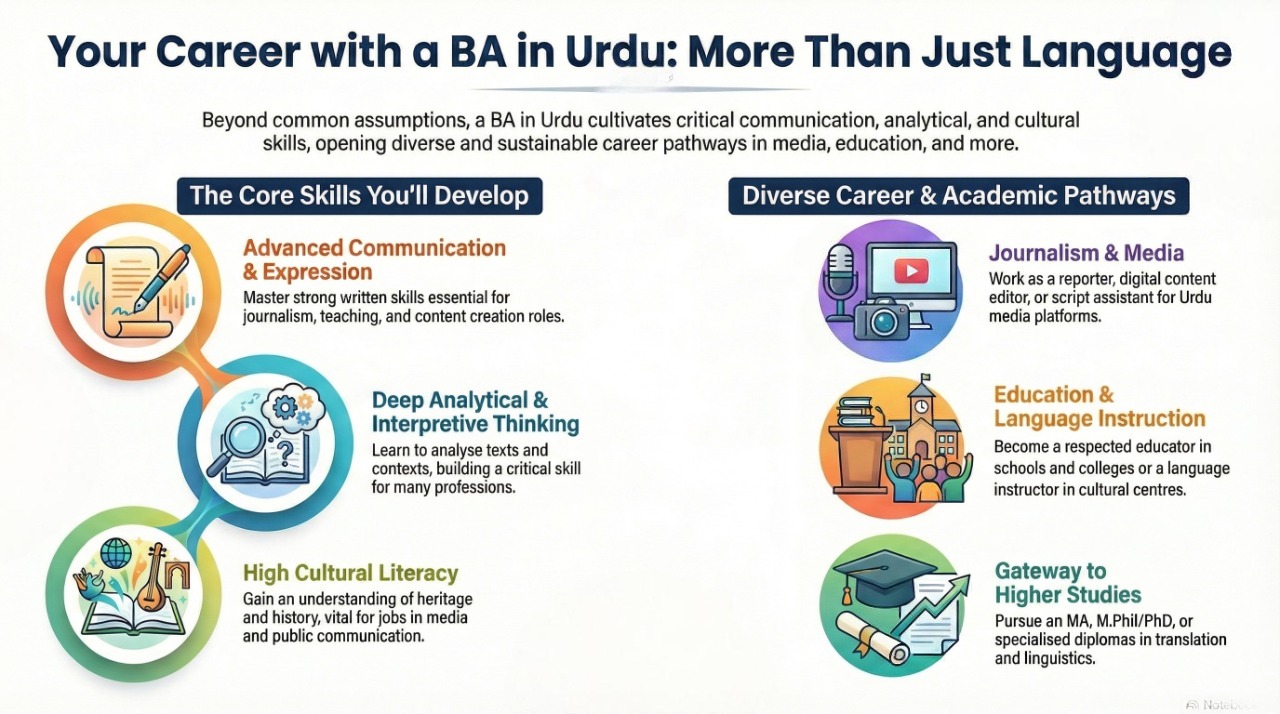
Urdu graduates today find opportunities across education, media, publishing, cultural institutions, and public service. The BA Urdu long term career opportunities are shaped by how students combine linguistic expertise with complementary skills such as research, teaching, content creation, or translation.
Some of the prominent Urdu language career paths include:
Journalism and Media
With regional and national media continuing to publish Urdu content, Urdu
journalism opportunities remain relevant. Graduates work as:
– Reporters and correspondents for Urdu newspapers
– Content editors for digital Urdu platforms
– Script and editorial assistants in broadcast media
Their ability to interpret events and communicate them accurately in Urdu is a
valued asset.
Literary and Creative Fields
Students inclined towards literature often pursue creative writing in Urdu,
contributing to:
– Poetry, short stories, and novels
– Literary magazines and journals
– Screenwriting and cultural storytelling projects
This path blends artistic expression with professional publishing opportunities.
Education and Language Instruction
One of the most stable and respected avenues involves teaching Urdu as a second
language. Graduates may work as:
– School and college educators
– Language instructors in cultural centres
– Tutors for learners seeking Urdu literacy or proficiency
With increasing interest in multilingual education, language instruction
continues to grow as a professional field.
Skills Developed Through a Language-Based Degree
A language degree builds far more than vocabulary or grammar. The Urdu language skills for professional growth include a combination of cognitive, communicative, and cultural competencies.
Students typically develop:
- Advanced reading and interpretation skills, enabling deep analysis of texts and contexts
- Strong written expression, useful in journalism, teaching, and content roles
- Cultural literacy, which supports work in heritage, media, and public communication
- Research and documentation abilities, particularly for academic or archival work
These skills collectively contribute to the broader BA Urdu career advantages, especially in professions where clarity of expression and contextual understanding are critical.
Academic Progression and Specialised Career Routes
Many students choose to deepen their expertise after graduation. The academic opportunities after BA Urdu include postgraduate study, research, and specialised certifications.
Common progression paths include:
- MA in Urdu or Comparative Literature
- Research programmes leading to M.Phil. or PhD
- Diplomas in translation, linguistics, or education
Some institutions also offer structured models such as BA Urdu with Apprenticeship, where academic learning is complemented by supervised professional exposure in educational or cultural organisations. This approach allows students to graduate with both theoretical knowledge and applied experience.
Key Benefits of Studying BA Urdu
Below are the major benefits of pursuing a BA in Urdu, with clear explanations:
- Strong foundation in language and expression – Graduates develop advanced communication skills that are transferable across teaching, media, and writing roles.
- Cultural and intellectual depth – Understanding literature and history builds analytical thinking and interpretive ability.
- Diverse career pathways – Opportunities exist across education, journalism, publishing, and cultural institutions.
- Academic progression options – The degree serves as a gateway to higher studies and research.
- Relevance in multilingual environments – Language professionals are increasingly valued in diverse communication ecosystems.
Frequently Asked Questions
Concluding Reflection
A BA in Urdu is not merely a study of language — it is an engagement with thought, culture, and communication. In modern career pathways that value expression, interpretation, and intellectual depth, Urdu graduates hold a distinctive position.
When combined with professional exposure, academic progression, or creative application, the degree offers meaningful and sustainable career possibilities. For students who appreciate language as both an art and a profession, BA Urdu continues to be a relevant and rewarding academic choice.